The Sigmoid Advantage: Why Linear Sales Commission Fail to Generate Revenue Upside
Is your sales compensation plan living in a flat world?
For decades, the default mechanism for sales incentives has been the Linear Curve. It’s safe, predictable, and easy to calculate in Excel. You sell 10% more; you make 10% more. But markets aren't linear. Buying behavior isn't linear. And human motivation definitely isn't.
As part of my new research initiative, "The Next Sellex" (Sales Expenses), I’ve been modeling payout curves to understand how we can better align Sales Incentives with Business Cycles. The initial findings suggest that this industry standard (Linear) might be inefficient for both the CFO and the Sales Rep.
Introducing the Sigmoid Curve and why I am betting on its potential:
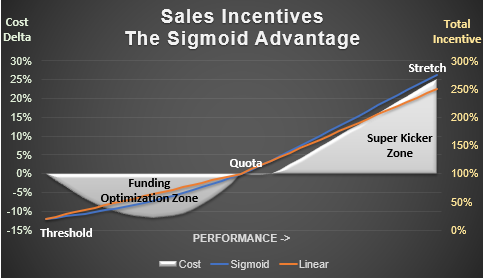
- The Flaw of "Straight Line" Logic Look at the data from a recent simulation I ran comparing a standard Linear Plan against a Sigmoid model.
At 80% Threshold and 100% Quota Achievement, both plans cost the company the exact same amount1. But the behavior they drive is radically different. In a Linear Model: • If a rep hits 90% of their number, they get paid 60% of their incentive. • It feels "fair," but it effectively subsidizes "near-miss" performance.
In a Sigmoid Model: • That same 90% achievement pays out only 48%. • The Insight: This saves the company upto 12% in payout costs on near misses and under-performance. This isn't punishment; it's reinforcing the Quota and optimizing the budgets to drive better productivity.
- Funding the "Super-Kicker" Where does this saved money go? It goes to the people excelling the quota. The Sigmoid curve is designed to cater to the Law of Diminishing Returns. As a rep pushes from threshold to quota, every incremental deal becomes harder to close. A linear plan ignores this friction. A Sigmoid plan acknowledges it.
From Threshold (80%) to Quota (100%) Achievement: o Linear Plan: pays Flat 4% commission on every 1% sales upside o Sigmoid Plan: accelerates this from 2% to 9% on every next 1% sales
At 120% Achievement (The Stretch): o Linear Plan: Pays 250% with straight 7.5% upside per 1% o Sigmoid Plan: Pays 275% with straight 9% higher upside
By tightening the belt on below target performance (80-95%), we can fund a massive 25% premium for the top performers without wrecking the overall cost impact on sellex.
- The "North Star" Effect The psychological impact of the Sigmoid curve is that it makes the "Target zone" (above 95-100%) the only safe place to be. • In a linear plan, landing at 90% feels "good enough." • In a Sigmoid plan, the drop-off below 95% is steep, forcing a behavioural focus on upside earing potential vs the sales, maximizing the Return on Effort for the Sales Rep.
Key Questions: Sales Leaders/Reps: • Would you trade lower payouts at 90% for significantly higher payouts above 100%? • Are you facing motivation challenges due to rigidity of your current Incentive payout plans and would want to have flexibility?
CFOs/CHROs/Rewards/Sales Ops • Do you want to maximize the sweet spot of maximum economic profit zone (95%-105% performance) and if your current linear incentives isn’t helping? • Are you having funding issues in your existing plans leading to unpredictability in forecasting & provisioning?